Media Owners
Scaling DOOH Revenue: Why Programmatic Access Alone Isn’t Enough (And What Media Owners Should Do Instead)
Struggling to scale DOOH revenue? Learn why programmatic access alone isn’t enough and how media owners can optimise pricing, inventory, and demand.

Saibhavani
Junior Executive - Growth Marketing
May 5, 2026

A significant portion of DOOH inventory remains underutilised across many networks.This is not a supply problem it’s a monetisation problem.
Screens are live, platforms are deployed, and operational control has improved significantly with the adoption of self-serve systems.
Yet, revenue growth continues to lag.
The issue is not operational inefficiency, it is structural. Demand remains limited, sales cycles are still heavily manual, and a significant portion of inventory remains underutilised. In many cases, inventory exists but is simply not discoverable at scale.
This is where programmatic infrastructure, specifically SSP integration, enters the conversation. Not as a technical enhancement, but as a mechanism to expand demand and improve monetisation efficiency.
Where DOOH Monetisation Fails
A closer look at most DOOH networks reveals a consistent pattern. Revenue is still heavily dependent on direct sales relationships, which inherently limit scale. Much of DOOH inventory continues to be bought and sold through direct sales and manual workflows rather than automated, programmatic channels, as highlighted in industry research from DPAA
As a result, growth becomes tied to the bandwidth of sales teams rather than the actual potential of the inventory.
At the same time, unsold inventory continues to persist not because there is no demand, but because that demand cannot easily access or evaluate the available supply. Campaign activation often requires coordination across multiple touchpoints, slowing down transactions and making smaller or time-sensitive buys less viable.
Even when networks expand by adding more screens, revenue does not scale proportionally. This exposes a fundamental issue: increasing supply without improving demand access only increases inefficiency.
Programmatic as a Demand Expansion Layer
SSPs are often positioned as part of the broader programmatic ecosystem, but for media owners, their role is far more direct. They function as a bridge between inventory and the environments where buyers are already planning and transacting.
By integrating with SSPs, inventory becomes accessible within DSPs and agency buying platforms. This reduces reliance on direct outreach and enables buyers to discover, evaluate, and activate campaigns more efficiently.
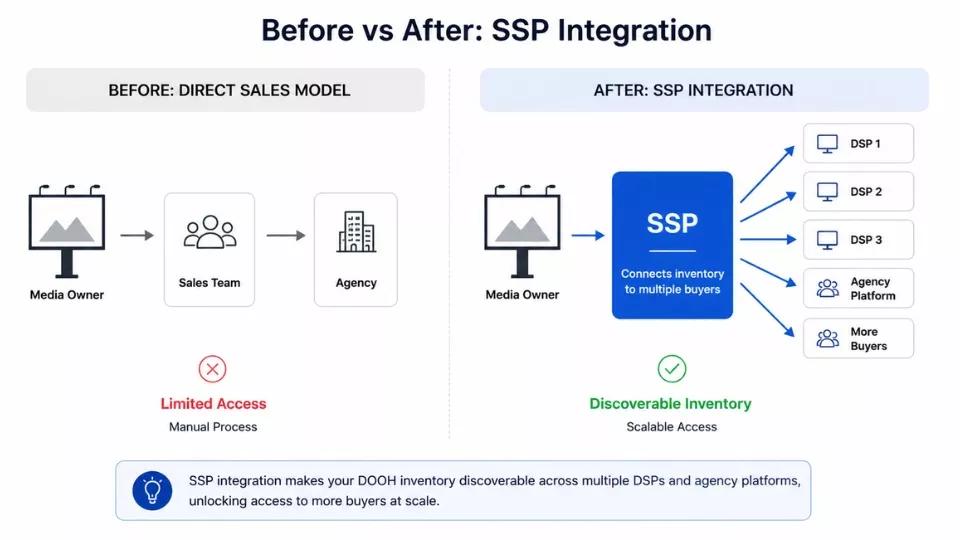
The impact can be significant when implemented with the right strategy. Inventory gains exposure to a wider pool of demand, unsold capacity has a higher chance of being monetised, and transaction cycles become significantly faster. In effect, programmatic shifts DOOH from a relationship-driven sales model to a more scalable demand-driven model.
Why Access Alone Does Not Translate to Revenue
However, increased access introduces a new layer of complexity.
When inventory enters programmatic environments, it becomes directly comparable to other supply sources. Buyers can evaluate options based on price, context, and measurable value. In this environment, undifferentiated inventory quickly becomes interchangeable.
The result is predictable: pricing pressure.
This is where many media owners misstep. They assume that broader demand access will automatically lead to higher revenue. In reality, without strategic control, SSP integration can accelerate commoditisation and erode margins.
The issue is not access to technology, it’s the lack of a commercial strategy behind it.
Turning Programmatic Into a Revenue Strategy

To scale revenue effectively, SSPs should be treated as a controlled demand channel, not a passive distribution layer.
1. Structure Inventory Strategically
Not all inventory should be exposed in the same way. Premium assets require tighter control and should not be made broadly accessible without strategic intent. At the same time, remnant or underutilised inventory can benefit from wider exposure through programmatic channels.
2. Maintain Pricing Discipline
In programmatic environments, buyers are constantly optimising. Without clearly defined and enforced pricing floors, inventory can risk becoming a discount-driven channel resetting expectations and weakening long-term revenue potential.
3. Build Differentiation Beyond Price
When inventory lacks clear value signals such as audience data, contextual relevance, or measurement capabilities it competes primarily on cost. This is difficult to sustain at scale. Strong positioning ensures inventory is evaluated based on value, not just price.
4. Balance Programmatic with Direct Sales
Programmatic is most effective when it complements direct sales. Direct relationships remain critical for maintaining pricing control and securing premium deals, while programmatic enables scalable access to incremental demand.
Where Platforms Like Moving Walls Fit
Understanding the need for structured inventory, pricing discipline, and controlled demand access is one part of the equation. Executing this consistently across a growing DOOH network is where most media owners face challenges.
Platforms like Moving Walls bring together inventory management, programmatic access, and measurement capabilities into a single environment. This allows media owners to structure how inventory is exposed, maintain pricing discipline, and access scalable demand without losing control over value.
This approach is already being applied in markets such as Japan and Vietnam, where media owners have scaled programmatic marketplaces while maintaining pricing control and attracting premium demand.
Rather than treating programmatic as a separate channel, this approach enables it to function as part of a cohesive revenue strategy.
The Core Balance: Control and Demand

DOOH monetisation ultimately depends on balancing control and demand. Too much control limits revenue potential, while unrestricted demand access can lead to pricing pressure and commoditisation.
Sustainable growth comes from ensuring inventory is accessible to the right demand while maintaining clear control over pricing and positioning.
Implications for Media Owners
As programmatic DOOH adoption accelerates, the competitive landscape is shifting. Inventory without sufficient demand access will struggle to deliver consistent returns, while inventory without differentiation or pricing discipline can lose value in increasingly competitive marketplaces.
SSPs are not a revenue solution on their own, they function as a multiplier. They amplify strong inventory strategy, but also expose weak positioning. Without clear control, they can contribute to pricing pressure and commoditisation.
Revenue growth will depend not on scale alone, but on how effectively inventory is structured, priced, and exposed to demand.
To stay competitive, media owners should focus on three priorities:
- Audit inventory exposure and access: Understand which assets are available programmatically, how they are packaged, and whether premium inventory is being appropriately controlled.
- Define pricing and access controls: Establish clear floor pricing and rules for how inventory is accessed across channels to prevent value erosion.
- Strengthen differentiation signals: Leverage audience data, contextual relevance, and measurement to ensure inventory competes on value, not just price.
Take Control of Your DOOH Revenue Strategy
Media owners don’t need more demand access, they need control over how inventory is structured, priced, and exposed across channels.
Moving Walls helps you assess your current setup, identify revenue gaps, and implement a more controlled, scalable monetisation approach.
Contact Us to understand where your inventory strategy is limiting growth, and how to unlock more consistent revenue.
Tags:Media Owners
Related Articles


Enjoyed this article?
Subscribe to get the latest insights, tips, and industry news delivered straight to your inbox.