Thought Leadership
Why Retail Transaction Data Is the Most Underutilised Asset in Advertising Today
Why is retail transaction data the most underutilised asset in advertising? Learn how Moving Walls connects point-of-sale data with DOOH to lift sales.

Navonil Roy
Head - Innovation
May 26, 2026

Retailers are sitting on a goldmine and most of them don't know it yet.
Every day, millions of purchase transactions flow through point-of-sale systems across grocery stores, supermarkets, and retail chains. This data tells you exactly what was bought, when, at which store, and in what quantity. It is arguably the most precise signal of real consumer intent that exists in marketing. And yet, for the most part, it sits idle, used internally for inventory planning, rarely weaponised for advertising decisions.
That is the problem Moving Walls set out to solve.
The 70% Problem
Consider this: average conversion rates for offline retail hover around 30%. That means seven out of every ten shoppers who walk through a store's doors leave without making a purchase. Every one of those visits still carries a cost rent, staff, utilities costs that grow consistently over time, regardless of whether a sale happens.
The traditional response to this has been more footfall, more promotions, more shelf space. But the real opportunity lies upstream, in understanding when and where shoppers are most primed to buy and reaching them with the right message at precisely that moment.
From Data Signal to Media Activation
Moving Walls has spent years building the infrastructure to translate audience movement and behaviour into actionable media intelligence. The company's patented MW Algorithm processes signals from traffic data, mobile SDKs, IoT sensors, and video enabling advertisers to plan campaigns around actual audience density rather than estimated location reach.
The next logical layer was transaction data: connecting what people buy to when and where they are most receptive to advertising.
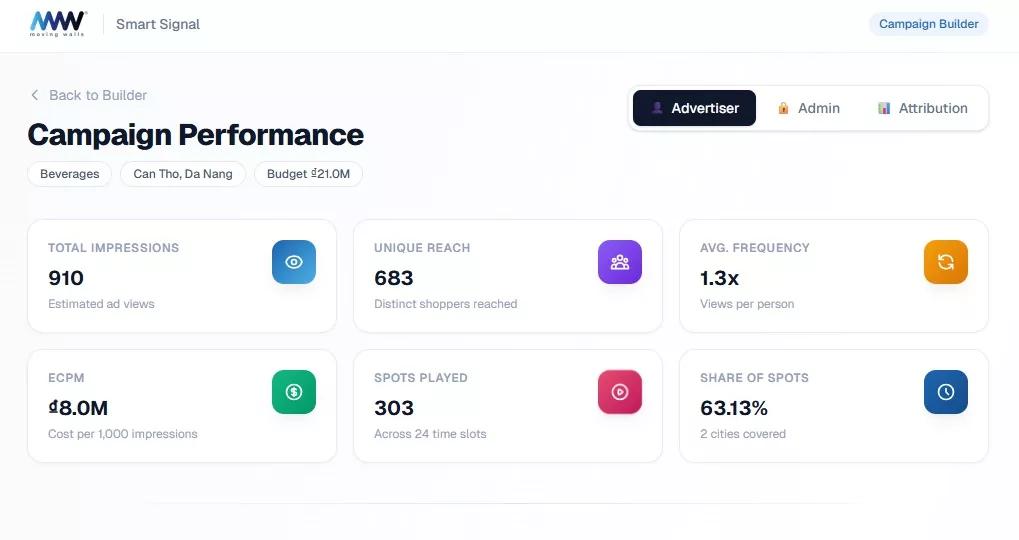
The concept is straightforward. A retailer's historical sales data reveals predictable peaks; certain product categories spike at specific times of day, on particular days of the week, at specific store locations. These patterns are consistent enough to be used as planning signals. If Beverages peak at a Can Tho store in Vietnam between 10am and 2pm on weekends, that is precisely when a beverage brand should be advertising on the Digital Out-of-Home screens inside and around that store.
Vicinity media, meanwhile, can drive incremental footfall toward the store during those high-intent windows turning what was previously a passive audience into an active one.
Privacy-First, Scale-Ready
One of the most critical design decisions in building this solution was ensuring that raw transaction data never needs to leave the retailer's environment. Moving Walls' signal builder accesses planning and attribution data without requiring the physical transfer of sensitive records. Advertisers simply set campaign parameters on a limited visibility set of categories : , city, budget, duration and the Artificial Intelligence based system handles the rest.
This is not just a privacy feature. It is a scalability feature. It removes the single biggest barrier to retailers monetising their data: the fear of exposure. With that barrier addressed, the path to broad adoption opens up.
A Working Prototype, Not a Whitepaper
What makes this particularly significant is that this is no longer a concept under exploration. Moving Walls has a live, operating prototype built on real transaction data from a few supermarket chains across different markets demonstrating end-to-end campaign creation, automated media planning, and attribution tracking. The attribution dashboard compares store-level sales during the campaign period against a pre-campaign baseline at the same store, making the impact measurable and defensible.
In some of the test campaigns, volume lift of +44.3% was recorded across comparable hourly windows, a meaningful signal that transaction-triggered DOOH works.
The Bigger Picture
Retail media is growing faster than search and social media did in their early years, and it is estimated to reach $180 billion globally, growing at a CAGR of 11–17% through 2030. The brands and retailers that build the infrastructure need to now open the data pipelines, the media partnerships, the attribution frameworks will be the ones that define how this channel matures.
Transaction data is the foundation. The screens are already in the stores. The audiences are already there.
The only thing left is to connect them and that work has already begun.
Tags:Thought Leadership
Related Articles


Enjoyed this article?
Subscribe to get the latest insights, tips, and industry news delivered straight to your inbox.