Why Measurement Matters More Than Ever
OOH does not have a demand problem. In many markets, occupancy rates remain strong and digital inventory continues expanding. Yet pricing pressure persists. The uncomfortable truth is this: inventory is often discounted not because it underperforms but because it is evaluated conservatively before a sales conversation even begins.
This is not a visibility issue. It is a credibility issue.
This credibility gap cannot be solved through reporting layers alone. It requires structured measurement infrastructure that standardises exposure logic, reconciles performance across markets, and aligns with modern planning systems. Measure by Moving Walls is built to address this structural shift enabling media owners to defend pricing authority before negotiation even begins.
As OOH competes within cross-channel budgets, measurement expectations follow a clear progression — from impression visibility, to reach and frequency modelling, to engagement validation, and ultimately to demonstrable business outcomes. Each stage reduces uncertainty in evaluation and strengthens commercial defensibility. Measure by Moving Walls is designed to support this evolution across inventory, campaign, and portfolio levels within structured buying environments.
The scale of the industry reinforces why this shift matters. According to IMARC Group, the global outdoor advertising market is projected to grow from approximately USD 43 billion in 2025 to over USD 70 billion by 2034. As investment increases particularly in digital formats, advertiser expectations around measurable, comparable exposure also intensify. Growth brings scrutiny.
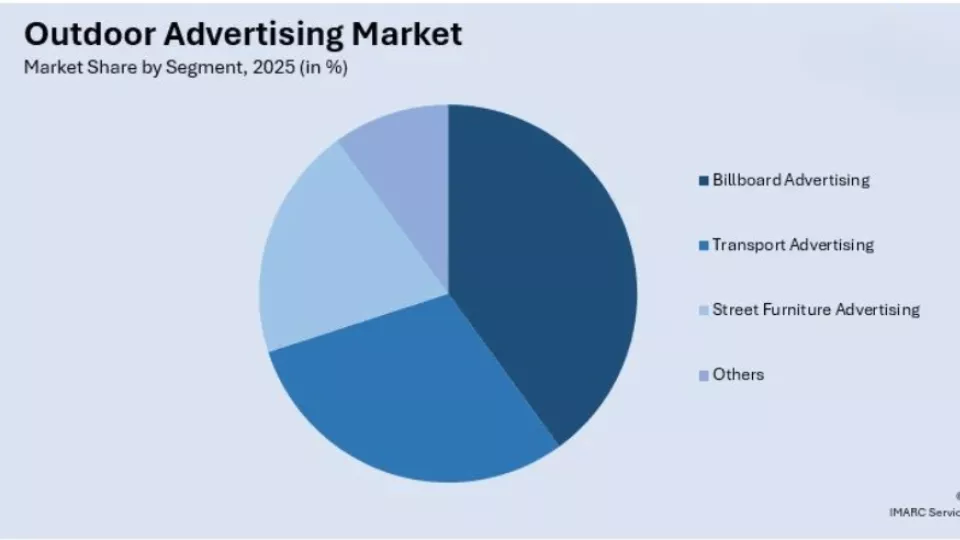
Source: IMARC Group
The New Rules of OOH Evaluation
Advertisers are no longer assessing OOH inventory just for its reach or location. Today, exposure is reviewed against four critical factors:
- Transparent methodologies that clearly define how impressions are calculated.
- Standardised logic that allows cross-market comparability.
- Alignment with advertiser systems for easy integration into broader plans.
- Consistency across regions to reduce uncertainty in multi-market campaigns
What’s changed is not just methodology, it’s comparison logic. Digital OOH expansion has quietly shifted how inventory is benchmarked. Premium screens are no longer compared only against other OOH assets. They are increasingly evaluated alongside other measurable channels in cross-media planning environments.
That shift raises the bar. Exposure is no longer judged only on visibility — it is judged on how easily it integrates into data-driven buying systems.
When these factors are unclear, media owners risk losing pricing power. Advertisers default to conservative benchmarks, which can lower revenue potential.
Why Traditional Visibility Metrics Fall Short
Industry bodies have formally recognised this shift toward measurable currency. The Out of Home Advertising Association of America, transitioned OOH trading to impression-based measurement standards, aligning the channel more closely with digital planning logic. This move signals a broader industry expectation: OOH exposure must be quantifiable, comparable, and transparent to compete for cross-channel budgets.
OOH’s strength lies in its ability to deliver impact and scale – a fact media owners understand well. High-traffic screens and premium locations remain valuable, but without measurable exposure, these strengths are harder to monetise.
When advertisers don’t trust or understand the data:
- Inventory becomes difficult to benchmark.
- Prime locations face greater scrutiny.
- Pricing discussions become defensive, not value-driven.
The challenge isn’t OOH’s effectiveness; it’s how that effectiveness is proven.
Consider a multi-market advertiser comparing two regional OOH networks. One provides standardised, impression-based exposure data aligned with planning tools. The other relies on varying methodologies across markets. Even if both networks deliver similar reach, the second is more likely to be benchmarked conservatively not because it underperforms, but because uncertainty increases risk inside the buyer’s evaluation model. That conservatism often translates into lower starting price assumptions
Standardisation: The Key to Confidence
In practice, achieving this level of consistency increasingly requires infrastructure that connects inventory management, audience data, and campaign reporting within a unified environment. Fragmented spreadsheets and isolated tools struggle to support cross-market comparability. As networks expand, programmatic integration and unified dashboards become less of an enhancement and more of a commercial necessity.
Media owners who embrace standardised measurement frameworks can unlock several benefits:
- Comparable reporting that builds advertiser trust.
- Seamless integration into global planning tools.
- Improved cross-market negotiations with reduced friction.
- Stronger pricing authority through consistent exposure definitions.
Inconsistent measurement, on the other hand, creates doubt — and doubt weakens negotiation power.
Real-world executions illustrate how structured measurement frameworks and proof-of-performance reporting reduce negotiation friction and strengthen cross-market confidence.

Source: Moving Walls x FC Media
Measurement Shapes Revenue, Not Just Reports
In today’s OOH landscape, measurement credibility increasingly determines pricing resilience. Media owners who invest in scalable, technology-backed measurement infrastructure rather than fragmented reporting layers will retain control over how their value is defined as buying environments become more automated and data-driven
Measurement is more than a post-campaign checkbox. It’s the foundation of pricing resilience. Media owners must ensure their data is:
- Transparent
- Standardised
- Comparable
- Trusted by buyers
By focusing on measurement credibility, media owners can transform their inventory from being seen as an approximation to a structured media asset. This shift strengthens pricing authority and protects revenue.
The Hidden Shift: Measurement as a Pre-Sales Filter
In many organisations, measurement is treated as a reporting layer — something that validates campaigns after execution. But buyers increasingly use measurement frameworks as a pre-sales filter. If exposure cannot be reconciled within their internal systems, inventory may be deprioritised before commercial engagement even begins.
This is where pricing power quietly erodes.
Media owners are not losing value because reach is weak. They are losing leverage because credibility now shapes how value is framed inside planning tools. Measurement is no longer just operational infrastructure. It is pricing infrastructure.
A Strategic Reflection for Media Owners
For commercial and network leaders, the critical question is no longer whether measurement exists; it is whether measurement strengthens pricing conversations before they begin.
Are exposure definitions consistent across markets?
Are methodologies transparent enough to prevent conservative benchmarking?
Is inventory being evaluated on your terms or on external assumptions?
In today’s OOH landscape, measurement credibility increasingly determines pricing resilience. Media owners who recognise this shift early will retain control over how their value is defined.
Scale up your OOH Ads with better ROAS today.