Performance Marketing Now Requires Revenue Accountability
Performance means measurable contribution to revenue outcomes. Today, agencies and brand leaders are increasingly evaluated on how media investment influences observable behaviours such as search activity, store visits, purchase intent, and long-term demand generation.
Nielsen’s 2024 Annual Marketing Report shows that approximately 70% of marketers are increasing their focus on performance marketing and 72% expect larger advertising budgets, yet only 38% measure holistic ROI across both traditional and digital channels. This gap reinforces the need for integrated revenue accountability models.
If DOOH is to qualify as performance media, it must be planned, measured, and integrated within the same accountability standards used across digital ecosystems. This shift can be understood as an Exposure-to-Outcome, a structured approach that plans, verifies, and measures how real-world exposure translates into commercial outcomes.

Source: Canva
The Planning Gap: Why DOOH Is Often Separated from Performance Conversations
DOOH is frequently excluded from performance reporting not because it lacks impact, but because measurement frameworks were not designed to account for physical-world exposure, as they were originally built to measure platform-based digital interactions.
Common structural barriers include:
- Performance budgets tied to platform-level KPIs
- Brand budgets owning DOOH investment
- Attribution windows that ignore upstream exposure
Most digital attribution systems operate within predefined conversion windows. When a consumer is first exposed to DOOH and later converts through search or social, the downstream digital channel typically captures full credit. The originating physical exposure remains structurally unaccounted for within platform-level reporting.
Consumer research illustrates this behavioural sequencing. The Nielsen Digital Billboards Report 2020 found that 65% of viewers reported taking an action after seeing a digital billboard, such as conducting an online search or visiting a store. This reinforces that physical exposure frequently precedes measurable digital or in-store behaviour, even when attribution systems fail to reflect it.
The solution is not to reject digital attribution. It is to integrate exposure-verified DOOH data into broader measurement systems such as Marketing Mix Modeling (MMM).
When DOOH exposure data feeds into MMM frameworks alongside digital spend, planners can assess incremental contribution to total revenue rather than isolated last-touch efficiency.
MW Planner addresses this gap by recognising that planning for physical media environments requires a different evaluation approach than platform-based digital buying. In OOH and retail settings, planners must consider how audience movement aligns with the commercial surroundings, contextual relevance, and the characteristics of each site. The platform brings together mobility insights, audience profiles, location data, and site-level attributes within a single planning interface. This supports both broader market planning and more granular, location-specific optimisation within the same workflow. Media selection is therefore informed by contextual and audience-based analysis rather than inventory availability alone.

Source: Canva
Integrating DOOH into Performance-Driven Campaign Planning
Effective integration requires structured planning and controlled measurement.
A. Planning DOOH Within Campaign Architecture
Performance-ready DOOH planning should:
- Identify audience movement patterns in high-intent environments
- Align placements with promotional windows and digital activation periods
- Forecast projected delivery before budget commitment
- Define measurable objectives tied to revenue indicators
MW Planner enables this by combining:
- Audience demographics
- Real-world mobility and movement patterns across relevant locations
- Location intelligence including commercial density and contextual relevance
- Budget and reach forecasting within a unified planning interface
This ensures DOOH investment begins with commercial intent rather than static inventory selection.
B. Linking Physical Exposure to Observable Outcomes
Measurement must go beyond estimated impressions. DOOH can be assessed through structured evaluation approaches such as:
- Store visitation analysis within defined trade areas.
- Mobility and movement pattern assessment across high-intent environments.
- Correlation modelling with digital engagement signals and branded search activity.
- Incrementality testing frameworks, applied where campaign scale and data sufficiency permit.
These methodologies enable agencies to evaluate DOOH’s role within a broader, integrated marketing architecture. Rather than attributing outcomes to a single channel in isolation, they provide a comprehensive view of contribution across coordinated touchpoints.
While MW Planner structures exposure strategy at the planning stage, performance accountability is completed through disciplined post-exposure measurement. Moving Walls Measure operationalises these approaches by integrating exposure validation, control-based incrementality analysis, and brand lift modelling within a unified framework. This ensures DOOH performance is assessed through structured, revenue-aligned metrics rather than isolated impression counts.
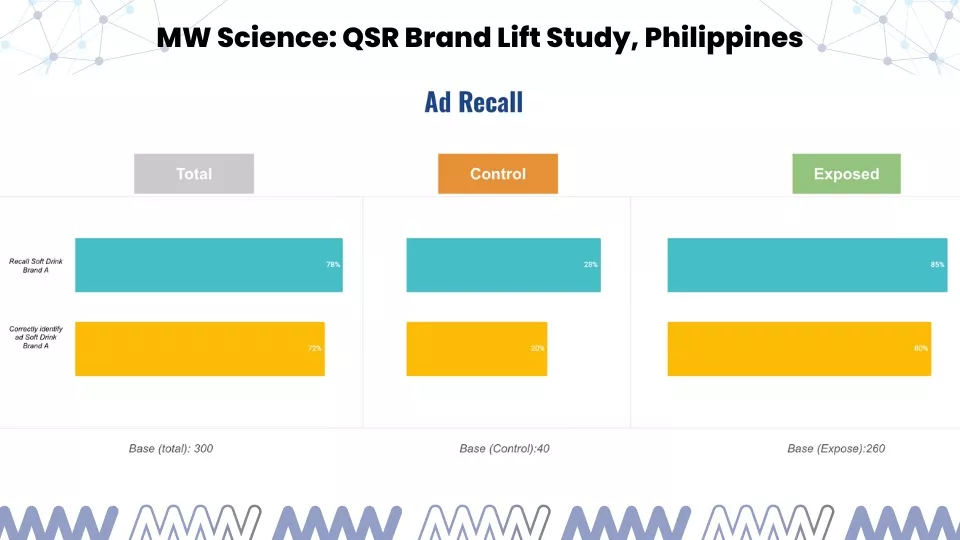
In a recent campaign for a leading global quick-service restaurant brand operating in Southeast Asia, DOOH placements were evaluated using a structured exposed-versus-control methodology.
Source: Canva
Results demonstrated:
- Campaign deployed across 14 digital screens in three metropolitan markets during a festive promotional period
- 300 respondents surveyed, segmented into exposed and statistically matched control cohorts
- 91% of exposed respondents expressed brand preference for Soft Drink Brand A ,materially higher than the matched control group
- 65% of exposed respondents indicated purchase intent, compared to 11% for the closest competitor within the same study sample
These findings represent measurable variance between exposed and control audiences, reflecting incremental shifts in brand preference and purchase consideration associated with verified DOOH exposure conditions.
C. Supporting Agency New Business Narratives
In competitive pitch environments, agencies must demonstrate how channels work together to drive revenue.
Structured DOOH integration supports this narrative by:
- Providing forecast-backed planning
- Validating exposure with movement data
- Measuring incremental lift rather than impressions alone
- Feeding exposure signals into MMM frameworks for holistic revenue modeling
For brands, this reduces tension between brand and performance teams. Instead of competing for budget ownership, DOOH becomes part of a unified measurement ecosystem.
4. Performance Efficiency in a Fragmented Media Landscape
Digital media remains essential, but incremental efficiency declines when investment concentrates solely on capture channels.
Physical exposure influences intent in high-attention environments. When integrated with search, social, and performance media within defined attribution windows, DOOH strengthens overall system performance.
Unified measurement requires more than lift analysis. It requires:
- Exposure validation
- Attribution window alignment
- Revenue impact modeling
This moves performance evaluation beyond last-click reporting.
Measurement and Accountability in Modern DOOH Planning
To qualify as performance-ready, DOOH campaigns should meet five criteria:
- Forecast audience delivery before activation.
- Validate exposure using verified mobility data.
- Construct statistically matched control groups.
- Measure incremental lift across brand and behavioural metrics.
Moving Walls Measure differentiates itself from generic programmatic platforms by combining exposure verification, control-based incrementality, and brand lift modeling within one framework.
Planning Implications for Agencies and Brands
To align DOOH with revenue accountability:
- Integrate DOOH planning into performance cycles early.
- Define attribution windows that reflect real-world decision timelines.
- Align DOOH activation with digital reinforcement within 7–14 day lookback windows.
- Incorporate exposure data into MMM analysis to assess revenue contribution.
This approach resolves the internal conflict between brand-building and performance objectives by anchoring both to revenue contribution.
Conclusion: From Reach to Revenue
DOOH does not need to compete with digital performance channels. It must integrate with them.
When agencies forecast delivery, validate exposure, measure incremental lift, and integrate results into unified measurement frameworks, DOOH becomes accountable performance media.
Revenue accountability demands influence that can be verified and modeled.
Moving Walls enables agencies and brands to plan with intent, measure with control, and report with confidence.Performance is not the last click. It is the measurable influence that precedes it. To explore how exposure-verified measurement can strengthen your revenue accountability model, connect with our team now!
Scale up your OOH Ads with better ROAS today.