March 6, 2026
Measure Beyond Impressions and Reach: Redefining OOH Through MW Science
Introduction: The Evolving Standard of Media Accountability
Media environments are fragmented. Campaign effectiveness is judged on proven business impact, not scale alone. Growth is measured through brand preference, purchase intent and incremental reach. Executives and finance teams expect measurable contribution and scrutinise media investment accordingly.
The challenge is structural. Audience movement patterns, location behaviour, and contextual relevance change continuously. Yet many media decisions are still based on historical studies and static reporting models. OOH is often reported through delivery metrics, while budgets are approved based on outcomes. MW Science addresses this disconnect by enabling behaviour-led evaluation rather than static reporting.
Out of Home reporting continues to focus on impressions, reach and frequency. These metrics validate delivery, but they do not clarify:
- Did exposure align with the intended audience?
- What measurable impact did the campaign generate?
- Were placements positioned in high-intent environments?
- How did OOH contribute alongside other channels?
If brands are evaluated on measurable growth, OOH must be assessed through a system that measures audience alignment, contextual relevance and incremental contribution, not exposure alone.
The Structural Measurement Gap
Digital channels are evaluated through behavioural indicators, lift studies and attribution modelling. Out of Home, by contrast, is frequently assessed primarily through delivery metrics such as impressions and reach.
This imbalance creates inconsistencies in cross channel accountability. When channels are measured differently, decisions may lean toward what is measurable rather than what is most effective. As integrated reporting becomes standard practice, OOH evaluation should progress from delivery validation toward understanding its role within the broader media mix. This places OOH within a clearer impact framework that recognises audience alignment and incremental contribution.
MW Science as an Analytical System
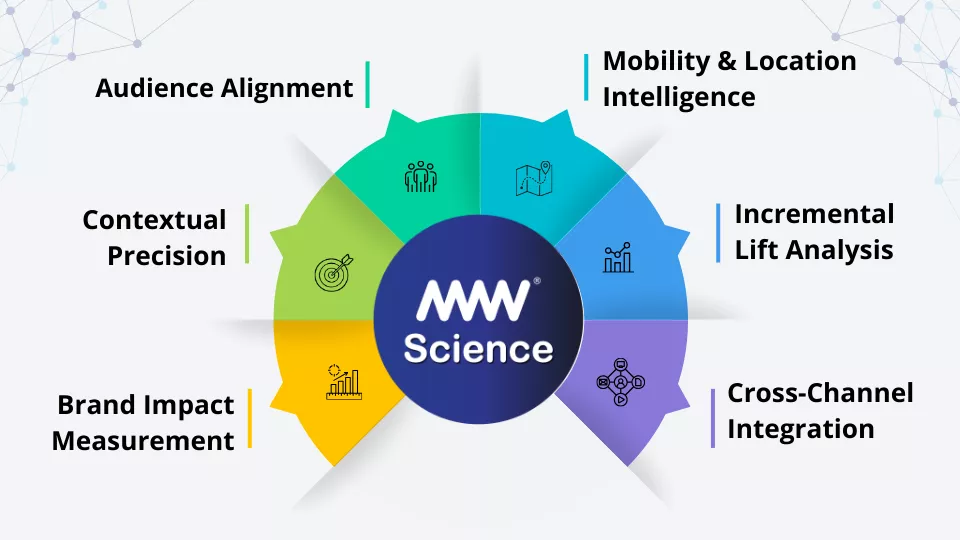
MW Science is designed as an analytical system embedded within the measurement process rather than as a reporting overlay. It elevates OOH evaluation from delivery validation to disciplined, model-based impact assessment.
Instead of relying on post-campaign studies, MW Science enables continuous insight cycles that accelerate planning decisions, support optimisation and improve in-market responsiveness.
MW Science integrates:
- Campaign exposure data matched with verified audience datasets
- Mobility and location intelligence including catchment analysis and heatmaps
- Statistically grounded methodologies, including exposed versus control cohort comparison and incremental lift modelling
- AI-driven predictive analytics to identify optimisation signals
- Scalable evaluation across markets and timelines
The system supports:
- Multi-market integration
- Near real-time measurement cycles
- Cross-channel compatibility
- Consistent benchmarking across campaigns
MW Science measures how OOH contributes to real outcomes rather than claiming direct sales attribution. Most OOH measurement tools stop at audience estimation. MW Science connects exposure, mobility and brand response into a single evaluation system.
Unlike standard digital dashboards that optimise within a single channel, MW Science evaluates physical and digital exposure within a unified contribution model.
Source: Canva
From Scale to Precision
Campaign scale alone does not determine effectiveness. Volume of exposure must be assessed alongside precision, contextual alignment and behavioural relevance.
As mobility patterns shift across time of day, geography and consumer routines, precision requires behavioural intelligence rather than static assumptions.
MW Science enables evaluation of:
- Alignment between exposure and defined audience segments using demographic, psychographic and lifestyle signals
- Contextual relevance of media placements within retail corridors, transport hubs, and commercial districts
- Mobility patterns surrounding placements, derived from anonymised, consent-based location intelligence
- Behavioural characteristics associated with exposure environments
This replaces volume-centric reporting with behaviour-led assessment.
Structured Brand Impact Assessment
Beyond audience validation, disciplined impact measurement is required to substantiate campaign effectiveness.
Within MW Science, brand lift methodology evaluates perceptual and intent-based shifts following campaign exposure. Exposure data is matched against verified panel and mobility datasets to identify audience segments with a high probability of exposure. A comparable group with similar attributes but without verified exposure enables structured comparison.
Both cohorts are surveyed using standardised brand lift instruments. Differences between exposed and comparison groups are analysed to quantify incremental shifts associated with campaign exposure.
This approach does not claim deterministic sales attribution. It provides evidence of brand impact grounded in controlled comparison and validated exposure modelling.
QSR Campaign Impact Evaluation
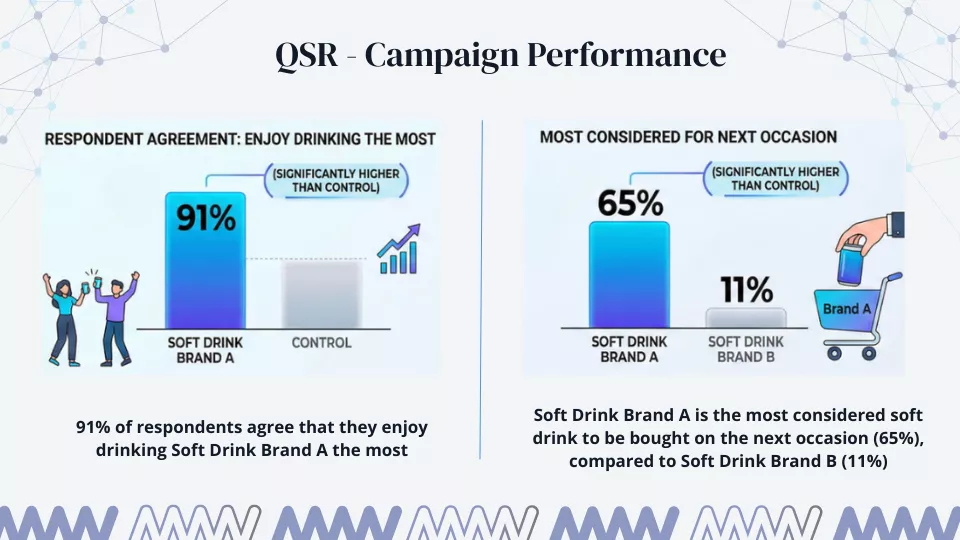
A post-campaign Brand Lift Study using MW Science evaluated a festive QSR campaign in the Philippines (July–October 2024), deployed across 14 digital screens in three cities.
Exposure data was matched with verified audience panels, with 300 respondents surveyed across exposed and comparison groups. The analysis identified significant uplifts in brand preference and next-purchase consideration among exposed audiences. The strongest effects were observed in zones demonstrating verified mobility overlap between media placement and purchase proximity.
These findings demonstrate how DOOH effectiveness can be assessed through structured brand impact measurement rather than distribution metrics alone.
Source: Canva
Cross-Channel Contribution and Incrementality
Modern campaigns operate across interconnected physical and digital environments. Evaluating channels in isolation no longer reflects operational reality.
MW Science supports:
- Exposure harmonisation across OOH and digital platforms
- Duplication and overlap analysis
- Incremental reach identification
- Media mix contribution modelling
Through unified modelling, agencies can assess OOH’s role within integrated campaign planning and make more informed budget allocation decisions.
Strategic Implications for Agencies and Brands
To move beyond impression-led evaluation, agencies and brands should:
- Embed measurement systems at the planning stage
- Align placement strategy with audience and mobility intelligence
- Integrate OOH insights into cross-channel reporting
- Establish benchmarking discipline across campaigns and markets
These shifts elevate OOH into a structured impact measurement ecosystem rather than treating it as a standalone exposure channel.
Conclusion: Toward Accountable OOH Evaluation
Impressions and reach validate delivery, but effectiveness requires deeper assessment. As performance standards evolve, OOH must be evaluated through systems that integrate audience precision, brand impact and cross-channel contribution.
MW Science enables this transition by embedding data intelligence into planning and optimisation processes, allowing agencies and brands to align OOH decisions with live audience behaviour rather than historical assumptions. To learn more about MW Science and structured OOH measurement frameworks, visit Moving Walls.
Scale up your OOH Ads with better ROAS today.