Media Owners
5 Steps Media Owners Must Take to Stay Competitive in the Programmatic DOOH Era
Discover 5 practical steps for media owners to centralize inventory, automate workflows, and maximize revenue growth in the evolving programmatic DOOH era.

Saibhavani
Junior Executive - Growth Marketing
June 19, 2026

Programmatic DOOH is no longer an emerging opportunity—it is becoming a core component of modern media buying.
According to MediaPost, nearly one-third of U.S. campaigns included a programmatic DOOH component over the past 12 to 18 months, with adoption expected to rise further in the coming months. As advertisers increasingly prioritise flexibility, audience-based planning, and omnichannel execution, media owners face growing pressure to make inventory easier to discover, transact, manage, and measure.
For many media owners, the challenge is no longer simply digitising screens. It is building the operational infrastructure required to support scalable monetisation across both direct and programmatic sales channels.
Fragmented inventory systems and disconnected workflows can create friction that slows campaign execution and limits revenue growth. In contrast, media owners that centralise inventory intelligence, streamline operations, expand demand accessibility, and improve measurement capabilities are often better positioned to compete for modern advertising budgets.
This article explores five practical steps media owners can take to strengthen operational readiness, improve monetisation potential, and remain competitive as the DOOH ecosystem continues to evolve.
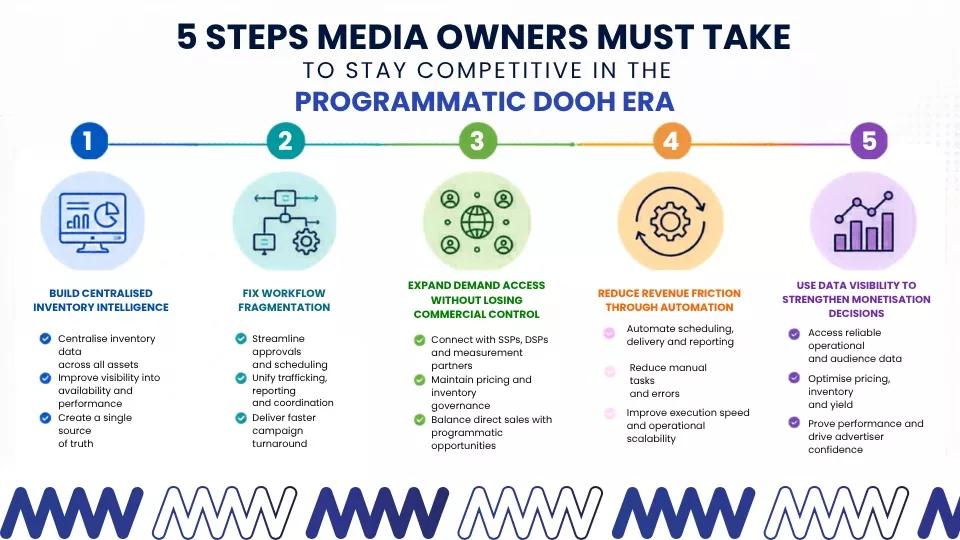
1. Build Centralised Inventory Intelligence Before Expanding Demand
Many media owners already have valuable inventory, but limited visibility into how that inventory is managed, accessed, and monetised across the network. Inventory data often remains spread across spreadsheets, regional workflows, and disconnected systems, making campaign planning and operational coordination more difficult.
As advertiser expectations evolve, media owners increasingly need a centralised view of inventory availability, screen metadata, campaign readiness, and network performance. Without this visibility, scaling monetisation efforts becomes more challenging.
This is where modular MediaTech infrastructure plays an important role. Rather than operating inventory management, campaign workflows, reporting, and monetisation as separate functions, connected platforms help bring these capabilities together within a unified operating environment.
MW Studio supports this approach by helping media owners centralise inventory management while maintaining flexibility across different asset types, including static OOH, DOOH, transit media, and retail media.
In Japan, jeki worked with Moving Walls to centralise the management of its transit media inventory through a unified platform. The implementation enabled the management of more than 36,000 screens, reduced manual administrative work by 85%, and supported real-time campaign activation across inventory reaching more than 17 million weekly commuters. The project demonstrates how centralised inventory infrastructure can improve operational efficiency while supporting scalable growth.
As advertising transactions become increasingly data-driven and programmatic, centralised inventory intelligence is becoming a foundational requirement for scalable growth.
2. Fix Workflow Fragmentation Before Scaling Programmatic Transactions
Expanding programmatic demand without addressing workflow inefficiencies can create operational strain rather than scalable growth. When campaign approvals, scheduling, trafficking, reporting, and inventory coordination remain fragmented, increasing transaction volume often amplifies existing bottlenecks.
Modern advertisers expect faster campaign activation, transparent reporting, flexible execution, and responsive campaign management. Media owners operating across disconnected systems may struggle to meet these expectations consistently at scale.
By centralising workflow management, media owners can reduce manual coordination, improve campaign turnaround times, simplify approvals, and create a more efficient transaction environment. This not only improves operational performance but also strengthens advertiser confidence by delivering a more reliable and measurable campaign experience.
As transaction volumes continue to increase across both direct and programmatic channels, workflow efficiency is becoming a competitive differentiator. The most successful media owners increasingly view workflow infrastructure not as an administrative function, but as a key enabler of revenue growth and operational scalability.
3. Expand Demand Access Without Losing Commercial Control
A common misconception among media owners is that programmatic DOOH reduces control over inventory and pricing. In reality, the right infrastructure can strengthen control while expanding access to new sources of demand.
As advertisers increasingly buy media across omnichannel environments, media owners need the flexibility to connect inventory with multiple SSPs, DSPs, measurement providers, and transaction channels. However, this should not come at the cost of pricing governance, inventory ownership, or commercial strategy.
Interoperable MediaTech infrastructure enables media owners to participate in broader demand ecosystems while maintaining control over how inventory is packaged, priced, and made available to buyers. This allows operators to balance direct sales relationships with programmatic opportunities rather than treating them as competing approaches.
MW Influence supports this model by helping media owners connect with modern buying environments while retaining flexibility over monetisation strategies and inventory access rules.
For media owners, programmatic should be viewed as an expansion layer that complements existing sales channels, increases inventory accessibility, and supports long-term revenue growth.
4. Reduce Revenue Friction Through Automation
As campaign volumes increase, manual processes can become a significant barrier to growth. Delayed approvals, fragmented trafficking workflows, disconnected reporting, and manual reconciliation often slow execution and create friction for both advertisers and operations teams.
Automation helps media owners streamline repetitive tasks across scheduling, campaign delivery, reporting, and operational coordination. This can improve execution speed, reduce administrative overhead, and support higher transaction volumes without proportionally increasing operational complexity.
The benefits extend beyond efficiency. Faster campaign activation, more consistent delivery, and improved operational responsiveness contribute to a better advertiser experience and can strengthen long-term commercial relationships.
As programmatic adoption continues to grow, automation is becoming a core component of scalable DOOH operations. Media owners that invest in connected, automated workflows are often better positioned to manage increasing demand while maintaining operational quality and control.
5. Use Data Visibility to Strengthen Monetisation Decisions

As advertisers place greater emphasis on measurable outcomes, audience accountability, and campaign transparency, access to reliable operational and audience data is becoming increasingly important for media owners.
Historically, inventory insights, audience intelligence, and campaign performance data were often distributed across multiple teams and systems, limiting visibility and slowing decision-making. This made it more difficult to optimise inventory value, improve pricing strategies, and demonstrate advertising effectiveness.
Modern MediaTech infrastructure helps address this challenge by providing broader access to operational and performance intelligence across commercial and operational teams. With greater visibility into inventory utilisation, audience movement patterns, campaign delivery, and network performance, media owners can make more informed decisions around pricing, inventory prioritisation, yield management, and advertiser strategy.
More importantly, stronger data visibility helps position OOH inventory as a measurable and accountable media channel within omnichannel advertising environments. As media buyers increasingly prioritise transparency and performance, this capability can become an important competitive advantage for media owners seeking to attract and retain advertising investment.
The Future Advantage Will Belong to Operationally Intelligent Media Owners
Programmatic growth is reshaping how inventory is managed, accessed, measured, and monetised across the OOH industry. While screen digitisation remains important, long-term competitiveness increasingly depends on the infrastructure that supports inventory visibility, workflow efficiency, automation, demand accessibility, and data-driven decision-making.
The media owners best positioned for future growth are those building connected operating environments that unify inventory, operations, demand access, and measurement into a scalable foundation for growth . By strengthening the foundations that support modern advertising transactions, they can create more scalable and resilient monetisation models without compromising control over inventory or advertiser relationships.
Ready to Future-Proof Your DOOH Operations?
Discover how MW Studio and MW Influence help media owners centralise inventory, streamline operations, expand programmatic demand access, and unlock scalable revenue growth.
Contact the Moving Walls team to explore how your network can build the operational infrastructure needed to compete in today's evolving DOOH ecosystem.
Tags:Media Owners
Related Articles


Enjoyed this article?
Subscribe to get the latest insights, tips, and industry news delivered straight to your inbox.