June 2, 2023
Stepping Up the Retail Game: How Programmatic DOOH Drives Measurable Footfall
Retail has never been more competitive. Digital channels are saturated, customer acquisition costs are rising, and online impressions do not always translate into in-store revenue. For retailers seeking measurable, incremental footfall, the question is no longer whether to advertise, but how to influence real-world behaviour at scale.
This is where programmatic digital out-of-home (PDOOH) changes the equation.
Unlike traditional out-of-home, which relies on fixed placements and broad assumptions about audience exposure, PDOOH combines the impact of high-visibility digital screens with the precision, automation, and data intelligence of programmatic buying. Unlike online display, it influences consumers in physical environments—close to stores, malls, transit hubs, and lifestyle districts—where purchase decisions are imminent. The result is not just awareness, but measurable store visits.
From Visibility to Visit: A Retail Impact Framework
At Moving Walls, we evaluate retail PDOOH performance using what we call the Visibility-to-Visit framework. It rests on three pillars: verified audience exposure, proximity relevance, and store visitation uplift.
First, verified exposure. Through our proprietary Moving Audiences planning platform, campaigns are built on audited, location-based audience data rather than estimated traffic counts. Retailers know who is likely to see their campaign, not just where it runs.
Second, proximity relevance. Screens are selected based on distance to store, catchment overlap, competitor presence, and behavioural movement patterns. Messaging can dynamically adjust based on time of day, weather triggers, or live promotions.
Third, visitation uplift. Using mobile location data partners and privacy-compliant exposure analysis, we compare exposed audiences against control groups to quantify incremental store visits. This shifts PDOOH from a branding channel to a performance medium.
Recent Retail Results: What the Data Shows
In 2024, a regional fashion retailer across Southeast Asia activated a six-week PDOOH campaign through Moving Walls to promote a mid-season sale. Screens were selected within three-kilometre store radii across high-traffic malls and transit corridors. Dynamic creatives updated daily to reflect live discount tiers.
The outcome: a 27 percent uplift in store visitation among exposed audiences versus control groups, and a 19 percent increase in average basket size during the campaign period. Notably, 38 percent of exposed visitors arrived within 24 hours of ad exposure, demonstrating PDOOH’s immediacy in driving action.
In another campaign, a specialty beauty retailer launching a new product line used audience-based targeting to reach urban professionals during evening commute hours. By aligning screen selection with mobility heatmaps and retail trading peaks, the campaign delivered a 22 percent incremental footfall increase and reduced cost per store visit by 31 percent compared to prior social media-only activations.
A third example comes from a consumer electronics brand operating pop-up stores in premium malls in early 2025. Using Moving Walls’ real-time optimisation dashboard, underperforming screens were swapped out mid-campaign, and creative messaging was adjusted based on dwell time analytics. The brand recorded a 34 percent uplift in pop-up visitation and achieved measurable cross-channel lift when PDOOH was run alongside paid social, reinforcing its role as a physical-world performance amplifier.
These results reflect a broader industry trend. According to recent global out-of-home industry reports, digital OOH is one of the fastest-growing media channels, with advertisers increasingly reallocating budgets from traditional display into programmatic outdoor due to stronger attribution capabilities and omnichannel synergy.
Why PDOOH Works for Modern Retail
Retail has shifted toward immediacy, localisation, and experience. Consumers expect timely offers, contextual relevance, and seamless movement between digital discovery and physical purchase.
PDOOH uniquely supports these shifts in several ways.
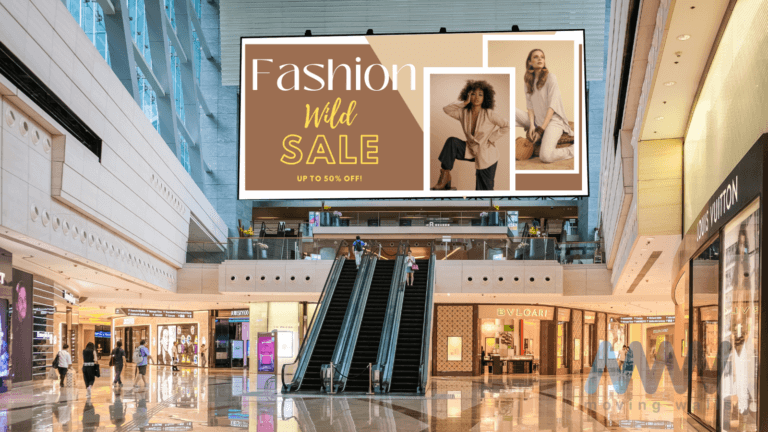
It captures high-intent audiences in real-world environments. Screens positioned near store clusters, lifestyle destinations, and transport nodes reach consumers when they are already in motion and closer to transaction.
It supports dynamic retail cycles. Seasonal sales, flash promotions, and limited inventory drops can be activated or paused instantly. Campaigns are not locked into fixed durations; they can scale based on performance data.
It strengthens omnichannel strategy. Retailers running paid search or social campaigns can align PDOOH placements with geographic hotspots where online engagement is strongest, creating a coordinated path from awareness to visit.
It enables measurable accountability. By integrating exposure data, mobile movement analysis, and dashboard reporting within the Moving Walls platform, brands can monitor visitation trends, optimise screen selection, and refine creative execution in near real time.
Addressing Common Retail Challenges
Retailers often hesitate due to concerns around measurement complexity, creative adaptation, or budget efficiency. PDOOH addresses each of these directly when executed correctly.
Measurement is resolved through controlled exposure methodologies and independent location data verification. Creative adaptation becomes an advantage rather than a barrier, as dynamic templates allow rapid iteration based on trading signals. Budget efficiency improves because programmatic buying allows retailers to bid on specific inventory aligned to target audiences, avoiding waste associated with blanket buys.
Is PDOOH Right for Your Retail Strategy?
PDOOH is particularly effective for retailers with physical footprints in urban or high-density areas, seasonal or promotional trading cycles, strong location-based targeting needs, or omnichannel ambitions requiring offline attribution.
It is also highly suited for store openings, mall takeovers, competitive conquesting near rival outlets, and event-driven campaigns where immediacy is critical.
Why Moving Walls
While many providers offer access to digital screens, Moving Walls differentiates itself through its integrated planning, buying, and measurement ecosystem.
Our Moving Audiences platform aggregates audited screen inventory across markets and layers it with mobility intelligence, demographic modelling, and behavioural segmentation. Campaign planning is built on real audience movement patterns rather than static traffic assumptions.
Our programmatic infrastructure enables automated buying, dynamic creative optimisation, and mid-flight adjustments. Retailers can monitor performance through a unified dashboard that visualises exposure, reach, frequency, and store visitation uplift.
Most importantly, we do not position PDOOH as a standalone tactic, but as a measurable driver of retail outcomes. Our focus remains consistent: verified visibility that translates into physical visits.
In an environment where every marketing dollar must justify its return, programmatic DOOH provides retailers with something increasingly rare—scale, precision, and accountability in the physical world.
The future of retail media will not be confined to screens in our hands. It will be built on intelligent screens in the environments where purchasing decisions actually happen. Retailers ready to move beyond impressions and toward measurable footfall will find PDOOH not just relevant, but indispensable.
Scale up your OOH Ads with better ROAS today.